Het Frontline EX Impact Model: Een businesscase bouwen die wél wordt goedgekeurd

Frontline medewerkers maken wereldwijd ongeveer 80% van de werkende bevolking uit. Zij vertegenwoordigen jouw merk elke dag opnieuw en vormen in de meeste organisaties ook de grootste kostenpost op de loonlijst. En toch is investeren in hun werkbeleving vaak het eerste wat sneuvelt als het budgetseizoen aanbreekt.
Het probleem is niet dat leidinggevenden het niet belangrijk vinden. Het probleem is dat "we moeten meer investeren in betrokkenheid" zelden een gesprek met de CFO overleeft.
Wat ontbreekt is een duidelijke, logische verbinding tussen de dagelijkse beleving van een frontline medewerker en de bedrijfsresultaten waar het leiderschap echt om geeft.
Precies daar is het Frontline EX Impact Model voor ontwikkeld. Samen met Dr. Dieter Veldsman, Chief HR Scientist bij AIHR, en onderbouwd door onafhankelijk onderzoek, geeft het je het framework, de taal en de tools om een businesscase te bouwen die wél beklijft.
In dit artikel nemen we je er helemaal in mee.
Wil je er dieper induiken? Bekijk het volledige webinar met Dr. Dieter Veldsman
Dit artikel legt de basis van het model uit en laat zien hoe je een business case opbouwt. Maar in het webinar dat we samen met Dr. Dieter Veldsman hebben opgenomen, gaan we veel verder. We nemen het model laag voor laag door, werken concrete use cases uit en laten zien hoe je het toepast in je eigen organisatie.
Klik hier om het volledige webinar te bekijken.
Gebaseerd op onafhankelijk onderzoek, niet op aannames
Wat het Frontline EX Impact Model onderscheidt van andere modellen: elke verbinding in het model is onderbouwd met onafhankelijk onderzoek. Elke relatie tussen een EX-conditie, een medewerkersuitkomst en een bedrijfsresultaat is gevalideerd via academisch en organisatieonderzoek, verzameld en beoordeeld door Dr. Dieter Veldsman.
Dat maakt een verschil als je aan tafel zit met een CFO, want je presenteert een model met een solide onderbouwing. Al het onderliggende onderzoek is publiek beschikbaar in deze Drive-map.
Deel 1: Het probleem begrijpen
Waarom budget krijgen voor frontline EX zo lastig is
Praat je met HR-managers in organisaties met veel frontline medewerkers, dan hoor je steeds dezelfde frustraties. De wil is er, de intentie is er, maar drie dingen gooien steeds roet in het eten.
1. Frontline EX voelt te vaag
Begrippen als betrokkenheid, verbinding, cultuur en employee experience zijn belangrijk, maar landen niet altijd goed bij zakelijke leidinggevenden.
Een CFO of operationeel directeur wil doorgaans weten:
- Wat gaat dit verbeteren?
- Wat gaat dit besparen?
- Wat gaat dit opleveren?
- Welk risico wordt hiermee verkleind?
De uitdaging is dus niet alleen het verbeteren van de frontline werkbeleving, maar het vertalen van EX naar zakelijke taal.
2. Het mist urgentie
Als de impact onduidelijk is, wordt het onderwerp minder urgent. En als iets niet urgent is, krijgt het doorgaans geen budget, eigenaarschap of aandacht van het leiderschap.
Zelfs als iedereen aan tafel het erover eens is dat de frontline werkbeleving beter moet, kan het momentum verloren gaan als de zakelijke impact niet concreet genoeg is. Goede intenties overleven een budgetvergadering niet op eigen kracht.
3. De ROI is moeilijk aan te tonen
De meeste HR- en operationele teams weten dat betere communicatie, onboarding, leren en betrokkenheid een verschil maken. Maar dat weten is niet altijd genoeg.
Om een sterke businesscase te bouwen, moet je kunnen laten zien hoe specifieke verbeteringen leiden tot meetbare resultaten, zoals:
- Hogere productiviteit
- Betere werkprestaties
- Lager personeelsverloop
- Minder verzuim
- Hogere klanttevredenheid
- Lagere vervangingskosten
En precies daar komt het Frontline EX Impact Model om de hoek kijken.
Deel 2: Het Frontline EX Impact Model

Hoe het model is opgebouwd
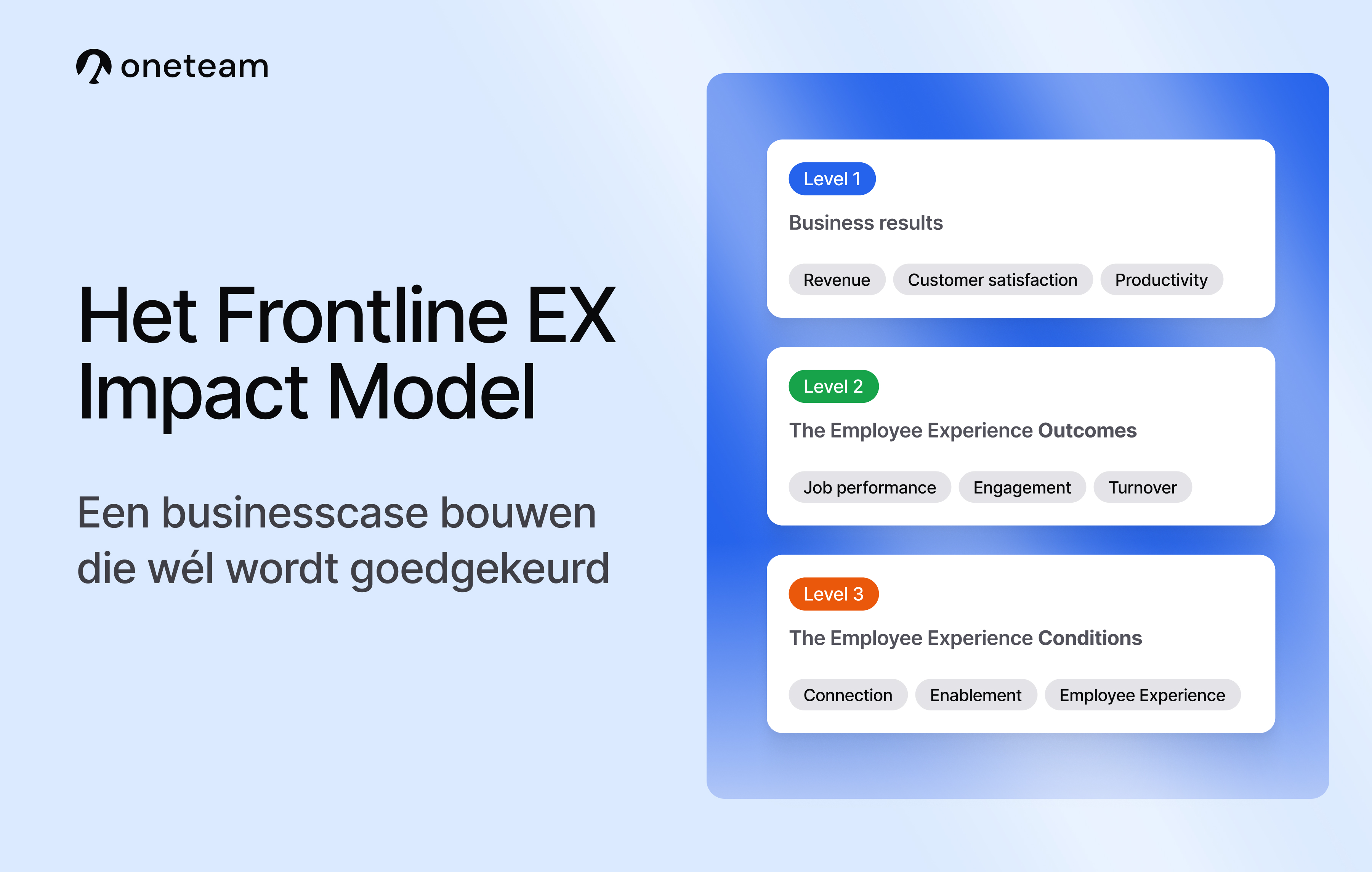
Het model is opgebouwd uit drie niveaus die op elkaar voortbouwen.
Niveau 1 Business results
Dit is de taal van de boardroom: omzet en groei, productiviteit, klanttevredenheid, concurrentievoordeel, innovatie en duurzaamheid op de lange termijn. Dit zijn de uitkomsten waar jouw organisatie uiteindelijk op stuurt.
Niveau 2: Employee Experience Outcomes
Dit is de laag die de meeste businesscases volledig overslaan, en dat is meestal ook de reden waarom ze niet landen. Wanneer de frontline werkbeleving echt goed is, zie je meetbare verschuivingen: betere werkprestaties, meer betrokkenheid en motivatie, minder verzuim en lager personeelsverloop.
→ Elk van deze uitkomsten heeft een directe invloed op de bedrijfsresultaten van Niveau 1.
Niveau 3: The Employee Experience Conditions
Dit zijn de drie gebieden waar HR daadwerkelijk actie op kan ondernemen. Ze beïnvloeden wat er op Niveau 2 gebeurt, wat op zijn beurt Niveau 1 beïnvloedt.
De drie condities zijn: Connection, Enablement en Employment Experience..
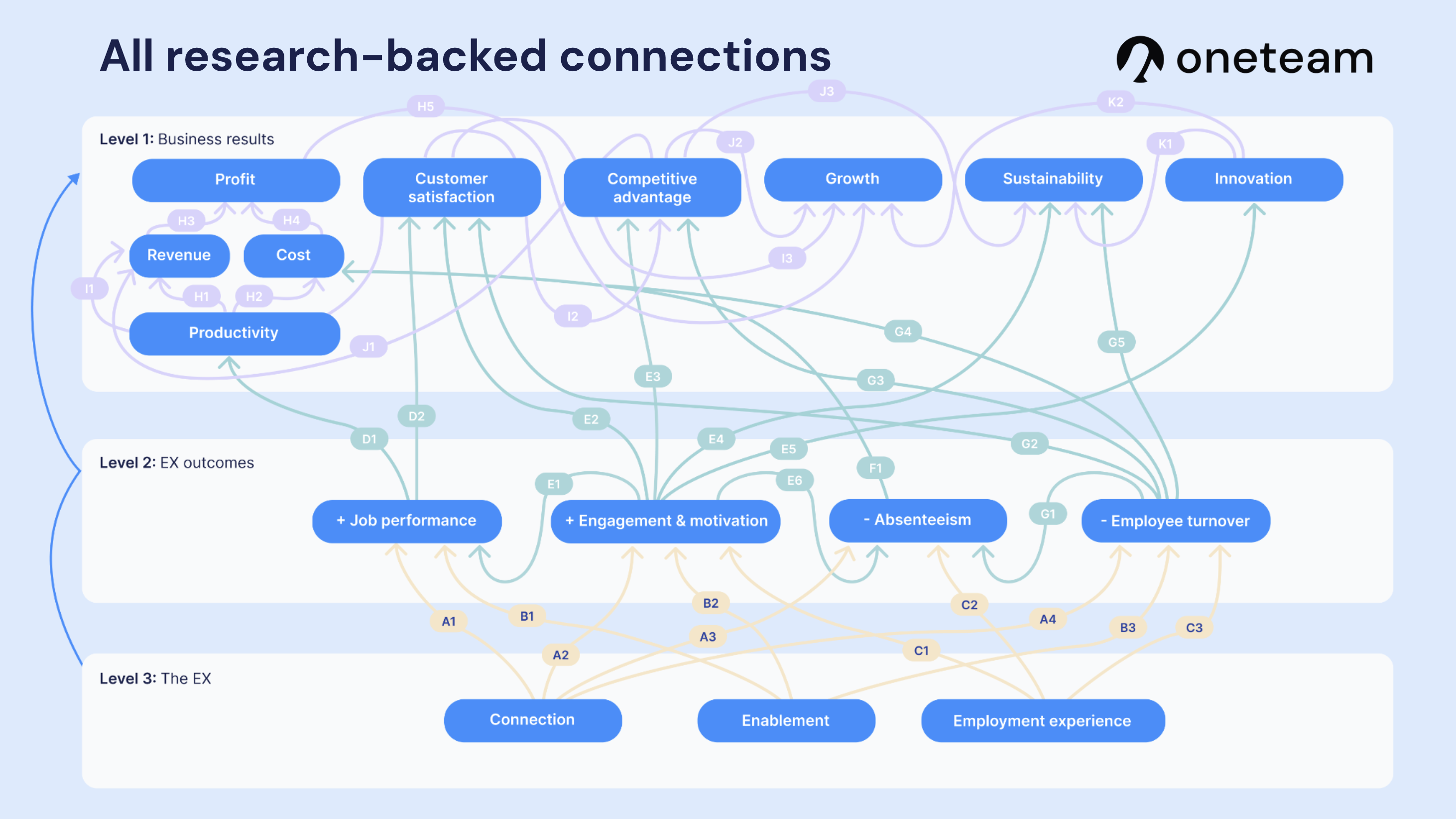
De logica is eenvoudig zodra je hem ziet: wat je doet op Niveau 3 bepaalt de uitkomsten op Niveau 2, die op hun beurt de resultaten op Niveau 1 bepalen.
Elk verband in het model is onderbouwd met onderzoek. Hieronder vind je een gedetailleerd overzicht van alle verbindingen tussen de verschillende onderdelen, en alle research kan je terugvinden in deze Drive folder.
De drie EX-condities uitgelegd
1. Connection
Verbinding gaat over de mate waarin frontline medewerkers zich echt ergens onderdeel van voelen, op drie niveaus:
1. hun directe team
2. hun leidinggevende
3. en de bredere organisatie
Stel je voor hoe het voelt om in één winkel van een retailketen met honderd vestigingen te werken. Jouw wereld is jouw team en jouw dienst. Als de enige manier waarop het bedrijf met jou communiceert een maandelijkse e-mailnieuwsbrief of een briefje op de prikbord in de pauzeruimte is, voel je je niet echt onderdeel van het grotere geheel.
Dat is precies wat H&M-medewerkers zeiden toen ze met Oneteam gingen werken. Hoewel medewerkers al met plezier met hun lokale team samenwerkten, voelden ze zich volledig afgesneden van de rest van het bedrijf. Er was een nieuwsbrief, er was een intranet, maar alles was eenrichtingsverkeer. Toen dat veranderde naar een tweerichtingskanaal waar medewerkers op alle locaties konden posten, reageren en met elkaar in gesprek gaan, was het verschil in betrokkenheid direct merkbaar.
"Connection" wordt beïnvloed door:
- De relatie die medewerkers hebben met hun team en directe leidinggevende
- Hoe het leiderschap communiceert met frontline teams, en of dat echt een gesprek is en geen eenrichtingszender
- Of medewerkers om feedback wordt gevraagd en of ze het gevoel hebben dat daar ook iets mee gedaan wordt
- De cultuur en het gevoel van verbondenheid dat mensen dagelijks ervaren

2. Enablement
Enablement gaat over de vraag of mensen hebben wat ze nodig hebben om hun werk goed te doen en daar ook het vertrouwen in voelen.
Dat begint bij onboarding. Weet een nieuwe medewerker na de eerste week wat hij of zij doet, of zijn ze een maand later nog steeds aan het puzzelen? Het gaat ook over voortdurende training, hoe operationele informatie de werkvloer bereikt en of mensen toegang hebben tot de juiste tools.
In snelbewegende sectoren zoals retail of horeca is dit extra belangrijk. Nieuwe productlijnen, seizoenscampagnes, aangepaste procedures, compliancewijzigingen: de hoeveelheid informatie die frontline medewerkers moet bereiken is aanzienlijk. Als de manier waarop die informatie bij hen terechtkomt onbetrouwbaar of inconsistent is, lijden de prestaties eronder en haken mensen af.
Het onderzoek is duidelijk: wanneer mensen goed gefaciliteerd worden, gaan de werkprestaties omhoog. Maar ook de motivatie stijgt, omdat er een directe link bestaat tussen je competent voelen en je betrokken voelen bij je werk.
"Enablement" omvat onder andere:
- Kwaliteit en opbouw van de onboarding
- Voortdurende training en e-learning
- Hoe operationele updates en instructies worden gecommuniceerd
- Toegang tot tools, systemen en informatie die nodig zijn voor het werk

3. Employment Experience
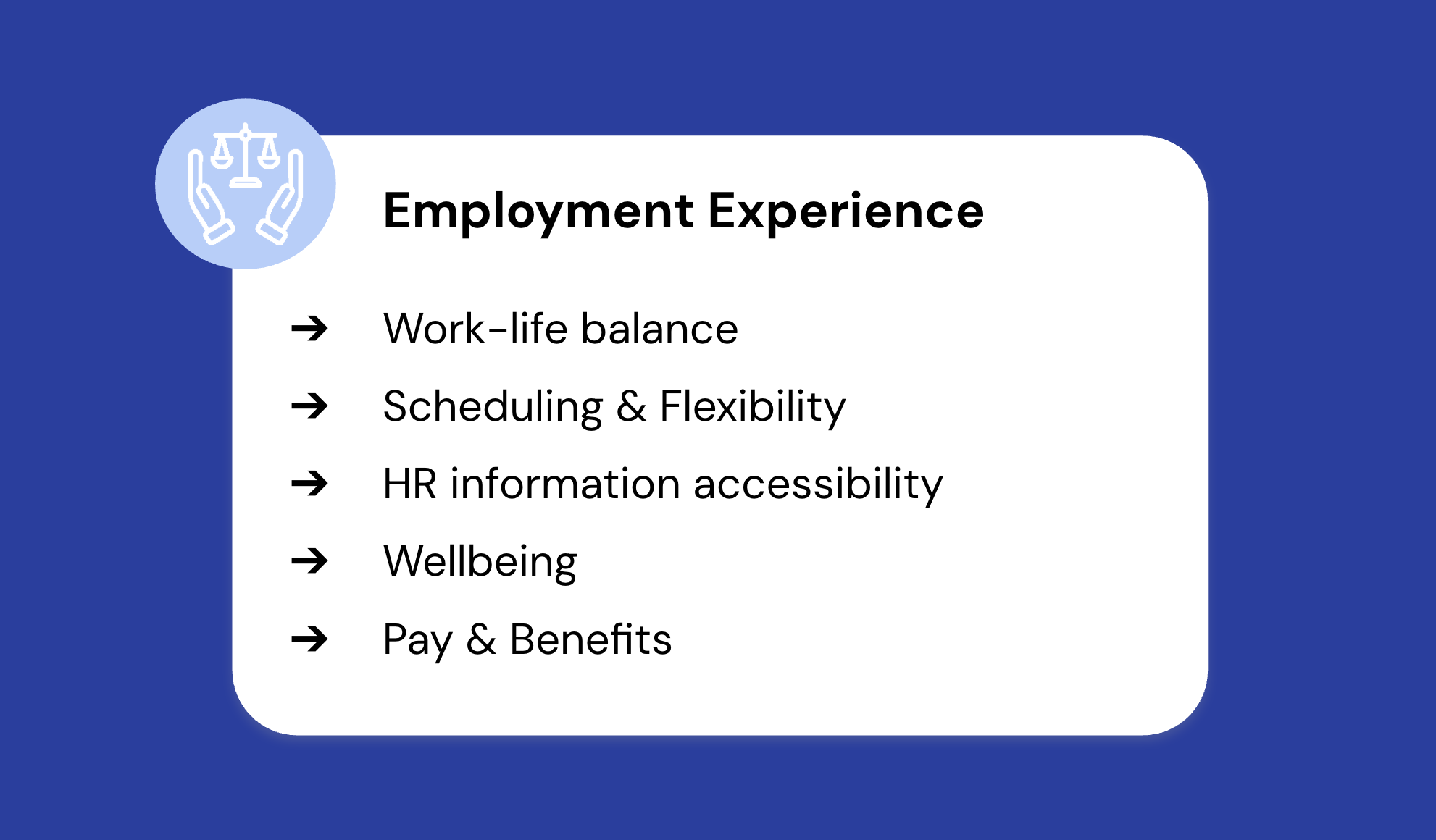
Dit is de dagelijkse realiteit van werken bij jouw organisatie. Van roostering en flexibiliteit tot de vraag of het werk op een oneerlijke manier in iemands privéleven doordringt.
Een voorbeeld uit de masterclass die we met Dieter hielden over het EX Impact Model illustreert dit goed: bij één organisatie kregen frontline medewerkers hun diensten toegewezen via een eenrichtings-sms. Gewoon een tijd en een datum. Geen mogelijkheid om te reageren, geen tweerichtingscontact. Dat ene detail zei veel over hoe die medewerkers werden gezien, en dat was direct terug te zien in het verloop.
Belangrijke factoren in de "Employment Experience" zijn:
- Werk-privébalans: worden medewerkers op hun vrije dag nog benaderd via WhatsAppgroepen?
- Roostering en flexibiliteit: krijgen mensen hun rooster op tijd? Kunnen ze diensten ruilen zonder veel gedoe?
- Toegang tot HR-informatie: kunnen mensen hun loonstrook, contract of verlofsaldo makkelijk inzien, of moeten ze daar achteraan bellen?
- Salaris, secundaire arbeidsvoorwaarden en welzijn: deze aspecten zijn niet altijd van de ene op de andere dag te veranderen, maar het is waardevol om te weten waar je staat ten opzichte van wat medewerkers verwachten.
Hoe het model werkt in zakelijke gesprekken
Het handigste aan het model is dat je er een directe lijn mee kunt trekken van HR-interventies naar bedrijfsresultaten, in een taal die in elke vergaderkamer werkt. Zo werkt dat uit in de drie gesprekken die HR-leiders het vaakst voeren.
"We moeten de productiviteit verbeteren."
Productiviteit wordt gedreven door werkprestaties. Werkprestaties worden gedreven door betrokkenheid en motivatie. Betrokkenheid en motivatie worden gedreven door verbinding en enablement. Jouw interventies richten zich op die twee condities, en het model laat precies zien hoe die omhoog doorwerken naar het bedrijfsresultaat.

"We moeten de klanttevredenheid verbeteren."
Klanttevredenheid wordt beïnvloed door drie dingen op Niveau 2: hoe goed mensen hun werk doen, hoe betrokken en gemotiveerd ze zijn (wat direct zichtbaar is in hoe ze met klanten omgaan) en hoe stabiel je personeelsbestand is, want elke keer dat iemand vertrekt, gaan consistentie en kennis mee.
Al deze uitkomsten worden bepaald door de drie EX-condities: connection, enablement and employment experience.

"We kunnen dit personeelsverloop niet blijven accepteren."
Hoog verloop heeft een harde financiële prijs: vervangingskosten, verloren productieve tijd en de investering om nieuwe medewerkers op snelheid te brengen. Maar het heeft ook een stillere, maar even reële prijs in concurrentievoordeel en teamstabiliteit.
Als je naar het model kijkt, zie je dat het meeste effect voortkomt uit de EX-outcomes "Employee turnover", die een direct gevolg is van alle drie de EX-condities.

Deel 3: De businesscase bouwen
Stap 1: Voer de EX Audit uit om je uitgangspunt te bepalen
Voordat je de case voor verbetering kunt maken, moet je weten waar je nu staat. Je kunt niet pleiten voor verandering zonder een nulmeting.
De 16-vragenlijst van Oneteam's EX Audit dekt de drie EX-condities en geeft je een score die weergeeft hoe frontline medewerkers momenteel de verbinding, enablement en hun dagelijkse werkomgeving ervaren.
Je kunt de vragen ook afnemen via je bestaande enquêtetool of simpelweg via Google Forms. Het belangrijkste is dat je eerlijke en representatieve antwoorden krijgt van je frontline medewerkers.
Een lage score is geen reden tot zorg. Het juist je sterkste argument: het betekent dat er aanzienlijke ruimte is voor verbetering, en dat is precies wat je nodig hebt om de case voor investering te maken.
Stap 2: Vertaal het naar cijfers met de gratis calculators
Met een nulmeting in handen is de volgende stap het concreet maken van de financiële case. Dit is waar veel HR-teams stoppen, omdat het kan voelen als giswerk.
Deze drie gratis tools zijn ontworpen om je te helpen stoppen met gissen en te beginnen met schatten op een manier die je kunt verdedigen.
- Personeelsverloop rekentool & benchmark: Schat je huidige verloopkosten en identificeer waar de grootste risico's in je personeelsbestand zitten.
- Rekenhulp: de kosten van personeelsverloop: Krijg een helder beeld van wat het jouw organisatie werkelijk kost elke keer dat iemand vertrekt en vervangen moet worden.
- Businesscase rekentool: Bereken de potentiële ROI van investeren in de frontline werkbeleving met Oneteam.
Een belangrijke noot: wees conservatief met je aannames. Het is veel beter om een verbetering van 5% te beloven en 8% te leveren dan andersom. Een belofte die je overtreft bouwt vertrouwen op. Een te optimistische belofte die tegenvalt doet het tegenovergestelde.
Na verloop van tijd, naarmate je meer eigen data verzamelt, worden je schattingen nauwkeuriger. Maar zelfs als startpunt geven deze tools je iets concreets en onderbouwds om mee een vergadering in te gaan.
Stap 3: Vergeet de kwalitatieve case niet
Cijfers openen de deur, maar sluiten hem niet altijd.
Naast de ROI-cijfers is er een kwalitatieve laag die je case versterkt. Wat betekent het voor je werkgeversmerk als frontline talent echt voor jou wil werken? Wat is de waarde van een personeelsbestand dat zich als echte ambassadeurs voelt? Wat doet het voor je cultuur, je teamstabiliteit en je groei op de lange termijn?
Deze elementen zijn moeilijker te kwantificeren, maar ze geven context en gewicht aan de cijfers. Ze helpen besluitvormers niet alleen de omvang van de impact te begrijpen, maar ook de aard ervan.
Stap 4: Breng alles samen in een case die aankomt
Dit is waar alles samenkomt.
Een sterke businesscase verbindt drie elementen: het model, de cijfers en het verhaal.
- Gebruik het model om de oorzaak-gevolgketen te laten zien. Maak duidelijk hoe verbeteringen in verbinding, enablement en werkervaring leiden tot meetbare verschuivingen in betrokkenheid, prestaties en behoud, en hoe die zich vertalen naar bedrijfsresultaten.
- Gebruik de uitkomsten van de calculator om die impact te kwantificeren op een manier die onderbouwd en realistisch is.
- Voeg vervolgens de kwalitatieve kant toe om het tastbaar en herkenbaar te maken. Help mensen zich het verschil voor te stellen tussen de huidige situatie en hoe het er in de praktijk beter uit kan zien.
En ga er niet vanuit dat je een groot, complex programma nodig hebt om te beginnen. Sommige van de grootste verschuivingen komen voort uit veranderingen die nauwelijks iets kosten: hoe het leiderschap communiceert met frontline teams, hoe onboarding is ingericht, of medewerkers het gevoel hebben dat er iets met hun feedback wordt gedaan.
Begin kleiner dan je denkt nodig te hebben. Kleine verbeteringen, consistent doorgevoerd in een groot frontline personeelsbestand, hebben een cumulatief effect en creëren meetbare impact sneller dan de meeste organisaties verwachten.
Conclusion
Als er één ding is dat je meeneemt uit het Frontline EX Impact Model, laat het dan dit zijn:
Als je wilt dat jouw medewerkers uitzonderlijke ervaringen leveren, moet je hun eerst een uitzonderlijke ervaring bieden.
Je ziet het overal zodra je erop gaat letten. De Google-recensies van een hotel. De energie bij een kassa. De manier waarop een bezorger je aan de deur begroet. De ervaring die jouw klanten hebben is, vaker wel dan niet, een directe weerspiegeling van de ervaring die jouw medewerkers op het werk hebben.
Het Frontline EX Impact Model geeft je het framework, het onderzoek en de praktische tools om die case te maken bij iedereen in jouw organisatie. Niet als een vage ambitie, maar als een concrete, meetbare en investeerbare prioriteit.


In dit artikel