The 5-layer onboarding blueprint your new frontline hires need


Most onboarding programs are built as one long course. Everything a new employee could possibly need to know, packed into their first day or first week. From the company story and the house rules, to the procedures and the safety instructions.
The problem? A new hire on day one needs completely different things than that same person in week three.
Dump it all at once, and most of it won't stick anyway.
The better approach is to build onboarding as a path with five layers, each with its own goal.
This blueprint is based on our analysis of 350+ frontline onboarding programs across retail, hospitality, logistics, and healthcare. You can read the full findings here.
This article is the practical part: how to actually build it, layer by layer, module by module.

Why onboarding works better in layers
The strongest programs we analyzed all share two habits:
1. They separate what a new hire must know before their first shift from what can wait. They dose information instead of dumping it.
2. They separate universal content from role-specific content.
- Universal content covers culture, company, tools, HR basics, and general safety. It's the same for everyone.
- Role-specific content covers department procedures, service standards, and product knowledge. It differs per role, and often per location.
Keep those two structures in mind while building. The five layers determine when someone learns something.
The universal/role-specific split determines what they learn and keeps your program maintainable as it grows.
Each layer answers one question:
- Layer 1: How do we make someone feel expected before they even start?
- Layer 2: What do they need to get through their first day with confidence?
- Layer 3: What do they need to actually do the job?
- Layer 4: How do they grow from "getting by" to "doing it well"?
- Layer 5: How do we keep knowledge alive after onboarding ends?
Let's go through them one by one.

Layer 1: Before the first day
Goal: take away uncertainty and make your new hire feel expected.
The biggest questions live before day one, and they're rarely about the job itself. Where do I need to be? What do I wear? Do I bring lunch? Who do I ask for when I walk in?
The best moment to start is right after the contract is signed, not the day before the first shift. That gap between signing and starting is usually silence, and silence creates doubt.
What belongs in this layer
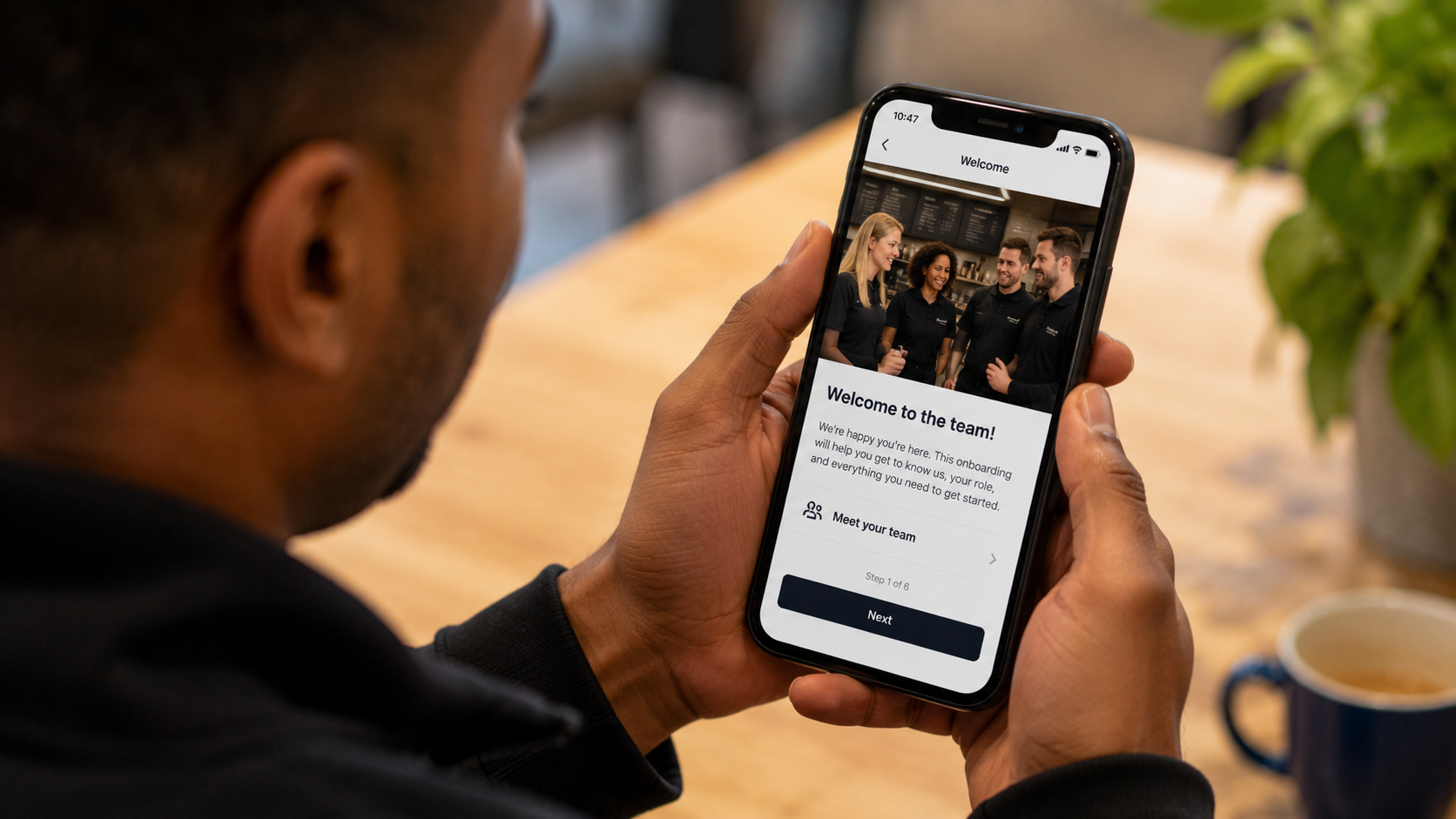
- A personal welcome message. Ideally a short video from the manager or the team. It doesn't need to be polished, it needs to be real. A 30-second phone video from the team beats a corporate production.
- Practical first-day information: where to go, what time to arrive, what to wear, what to bring, who to ask for at the door. Answer the questions people feel embarrassed to ask.
- A short company introduction: who you are, what you do, who you serve. Two or three screens is enough. The full story comes later.
- App and login setup, so day one doesn't start with password problems. If employees need to install an app, let them do it now, at home, at their own pace.
- A simple first-day checklist the new hire can look at the day before.
How to build it
Keep this layer light and warm. Three to six short screens. Use photos of the actual team and workplace, so the new hire recognizes faces and places when they walk in. Save the procedures for later.
Common mistake: skipping this layer entirely and cramming everything into day one. By then, nerves are high and attention is low.
The second mistake is the opposite: making pre-boarding so heavy that it feels like homework before the job has even started.
.png)
Layer 2: The first day
Goal: get through the first shift feeling oriented, not informed about everything.
Day one is full of impressions: new faces, new spaces, new rules. The programs that handle this well are strict about what makes the cut. The test for every piece of content: does someone need this today? If not, it moves to a later layer.
The company story and values
Not just "our mission is X," but who you are, what makes you different, and what that means on the floor. Use real photos and short videos of locations, products, and people. A good benchmark from our analysis: after this module, a new hire should be able to explain to a customer what the company does and why it matters.
And treat values as behavior, not words. Instead of "we value hospitality," show what that looks like during a shift: how you greet a guest, how you handle a complaint, what a great interaction sounds like versus a poor one. One or two concrete examples of great behavior in practice do more than a full page of value statements.
House rules and safety essentials
Only what's needed for the first shift: emergency exits, who to alert when something happens, hygiene basics if relevant, the non-negotiables. Keep the complete rulebook in a separate, searchable module (more on that in layer 5). For the first day, a short checklist is enough.
A "who does what" overview
This was one of the most underused patterns in our analysis. Give it its own module, early: which departments exist, what each one owns, who to go to for what, and what information they need from you.
In multi-location organizations, add the local version: who is my manager, who does the schedule, who handles HR questions here.
The tools
Where to find the schedule, how to request time off, how internal communication works, where documents live, and where questions go. Use screenshots or short screen recordings, so people see exactly what to tap.
And set expectations while you're at it: what belongs in a chat message, what belongs in a form, and what's a conversation for your manager. That one distinction saves managers a lot of repeated questions later.
What the first shift will look like
Walk through it step by step: when to arrive, what happens first, who you'll be working with, when breaks are. Predictability lowers stress.
One thing worth adding here that many programs miss: a buddy. Assign someone whose explicit job is to be the "ask me anything" person for the first weeks. It lowers the barrier for all the small questions a new hire won't ask a manager, and it builds connection with the team from day one. Mention the buddy by name in the onboarding, with a photo.
How to build it
Aim for short modules with clear, practical names. Our analysis showed that the strongest programs use action-oriented module names: "House rules," "Where to find your schedule," "Who does what," "Your first shift." A new hire should be able to find any module back later just by its name.
Common mistake: filling day one with policy documents and compliance text. Rules matter, but nobody remembers page twelve of the house rules after their first shift. Keep compliance content short, searchable, and separate, so people can look it up when they need it.

Layer 3: The first week
Goal: teach the actual work, from shadowing to contributing.
This is where onboarding earns its keep. The first week should focus on the role itself: the procedures, the standards, and the knowledge someone needs to be genuinely useful on the floor.
This is also where the universal/role-specific split becomes essential: from this layer on, content differs per role and often per location.
Role-specific procedures, one module per workflow
- Opening and closing routines.
- Shift start and shift end.
- Cleaning and preparation.
- The register or payment process.
- Orders, bookings, or reservations.
- Handovers between shifts.
- Stock or inventory basics.
Build each one as a step-by-step module, and add photos or short videos of the real workspace. Within each procedure, separate "must do every time" from "good to know." For steps that have to be followed exactly, use a checklist format.
Service standards, built as real situations
This was one of the clearest patterns in our entire analysis: scenario-based content consistently beats policy text for anything customer-facing. Cover the moments that matter:
- The greeting: what does a good first contact look like here?
- The complaint: what do you say, what do you never say, and when do you get your manager?
- The difficult customer: how do you stay professional and when do you escalate?
- The upsell or advice moment: how do you help a customer without being pushy?
- Service recovery: something went wrong, how do you fix the experience?
Give employees actual language they can use. Example phrases for a greeting or a complaint response make the standard concrete and take away the fear of saying the wrong thing.

Product knowledge: only the "must know" layer
Nearly every organization teaches what they sell, serve, or operate: menus, rooms, treatments, products, processes. The trick is prioritizing the 20% that prevents mistakes and builds customer confidence. Three good filters for what belongs in week one:
- What do customers ask about most often?
- Where do mistakes hurt: allergens, safety, pricing, promises we can't keep?
- What does someone need to not feel lost during a shift?
Everything else moves to layer 4.
How to escalate
What do you do when something goes wrong mid-shift and your manager isn't around? Who do you call, in what order? A simple escalation path, one screen, prevents both panic and wrong decisions.
Short knowledge checks after every critical module
Not trivia, but scenario questions close to the behavior you want on the job:
- "What would you do if..."
- "Which steps are in the right order?"
- "Where can you find..."
These checks do two things at once:
- They confirm understanding for the employee
- They show you where your content isn't landing
If half your new hires get the same question wrong, the problem is the module, not the people.
Common mistake: treating product knowledge as one big download. Split it into "before your first shift" and "learn over the coming weeks," and the first week instantly becomes lighter and more effective.

Layer 4: The first month
Goal: build depth and independence. From "I can run my shift" to "I do it well, on my own."
After a few workdays, a new hire has the basics. Now there's room for depth: the knowledge and context that turn someone from functional into good.
This layer is often where onboarding programs go quiet, and that's a missed opportunity. The first month is where engagement and connection with the team and organization is either built or lost.
What belongs in this layer
- Deeper product, menu, or service knowledge: the "learn later" layer you set aside in week one. Frequently asked customer questions, background stories, details that help an employee advise with confidence.
- More advanced procedures and quality standards: what does "good" look like here, beyond just "done"? Include examples of great work versus acceptable work.
- The brand story and customer promise, in more depth. Now that someone has stood on the floor for a few weeks, the "why" behind the standards actually lands.
- How departments work together: what happens before and after your part of the process, and how your work affects the next person in the chain.
- HR policies in more detail: leave requests, sick reporting, evaluations, the probation period, growth paths. Put the practical employment basics in one clear module, and answer the questions people are often embarrassed to ask.
The check-in moment
This is also the moment for a real check-in, where the new hire and their manager have a conversation. Is everything clear? Is the role what you expected? What was missing from your onboarding so far?
Many organizations time this around the end of the probation period, which makes it a natural moment to take stock, both ways.
Prepare managers for this conversation with two or three fixed questions, so it actually happens and doesn't depend on who the manager is.
A refresher check also fits here: a short quiz revisiting the critical knowledge from week one. Safety steps, service standards, key procedures. Not to catch people out, but to see what stuck and what needs another pass.
Common mistake: letting onboarding quietly stop after week one. A single check-in conversation and one refresher module cost almost nothing, and they're the difference between someone feeling launched and someone feeling dropped.
.png)
Layer 5: Ongoing learning
Goal: keep knowledge alive after onboarding ends, instead of letting it become a one-time information dump.
A good onboarding program doesn't really end. It turns into a reference: the place where employees keep finding rules, procedures, contacts, and updates long after their first month.
In our analysis, this reference value was one of the things that separated the strongest programs from the rest. The employee gets confidence; the manager gets fewer repeated questions.
What belongs in this layer
- Refresher modules for safety and compliance topics, repeated periodically instead of covered once. Some knowledge is too important for a one-time module. Our analysis surfaced a clear list of high-risk topics that deserve this treatment:
- emergency procedures
- food safety and hygiene (HACCP)
- privacy and GDPR
- cash and payment handling
- safe equipment use
- incident reporting
- any other role-specific protocol where mistakes affect quality or safety
- Modules for growth: next steps, new responsibilities, cross-training into other departments. Onboarding content and development content can live in the same structure.
- A feedback question about the onboarding itself: "Was anything missing from your onboarding?" One question, asked at the end of the first month, gives you a continuous stream of improvement input.
Use feedback and quiz results to keep improving
Your newest employees are your best onboarding reviewers, because they just went through it. Combine their feedback with your quiz results: if a module gets poor feedback and poor quiz scores, you know exactly where to improve. Some of the best programs we've seen were partly built with input from the people who recently completed them.
Common mistake: letting content go stale. The moment employees find outdated information once, they stop trusting the whole thing. So make sure to put a simple review rhythm on your high-risk and fast-changing modules.
.png)
Getting the format right
A quick word on format, because it matters more than most people think.
Across the strongest programs in our analysis, the same format principles kept coming back:
- One screen, one topic. A screen should answer one question or teach one action. Long policy text should be split into smaller screens with clear headings.
- Use each medium for what it's good at. Text for clear instructions and searchable information. Photos for locations, products, teams, and visual standards. Video for welcomes, walkthroughs, and tone. PDFs for reference documents people may need later. Quizzes for confirmation.
- Use real material. Photos of your actual workplace and team beat stock imagery every time. A slightly shaky video of a real colleague explaining a real procedure builds more trust than a polished animation.
- Localize where it matters. If you have multiple locations, keep universal content central and add local modules for location-specific knowledge: the building, the team, the local contacts, the local variations in procedures.
The onboarding checklist: must-haves for every frontline program
Use this as your baseline. If a topic below is missing from your program, that's your starting point:
- A warm welcome, before day one
- Practical first-day information
- Company story, mission, and values
- A "who does what" overview of teams and departments
- House rules
- Safety, hygiene, or compliance basics, kept short and findable
- How to use your tools and where to find the schedule
- HR basics: sick reporting, breaks, leave, payslips, probation period
- Role expectations: what does success look like in the first weeks?
- Service standards, built as scenarios with example language
- Role-specific procedures, step by step, split into "must do" and "good to know"
- Product, service, or facility knowledge in two layers: day one and later
- An escalation path for when something goes wrong mid-shift
- Short knowledge checks after critical modules
- A buddy or go-to person for the first weeks
- A check-in moment within the first month
- A refresher rhythm for high-risk topics
- A feedback question about the onboarding itself
Strong add-ons, if you want to go further: a video welcome from leadership, a location tour, a meet-the-team module, an opening/closing checklist, and a first-week checklist the new hire can tick off themselves.

How to start: small first, then build
You don't need to build all five layers at once.
Start with layers 1 and 2: make new hires feel expected, and give them a confident first day.
Then watch where the questions keep coming, because repeated questions are your roadmap for what to build next. Every question a manager answers twice is a module waiting to be made.
And involve your team while you build. Your managers know what new hires struggle with, and your recent hires know exactly what was missing. Together, they'll get you to a strong program faster than any template will.
One final reframe, because it's the core of everything above: a strong onboarding program is not a welcome course.
It's a structured path from "I am new here" to "I know where I am, who I work with, what matters, how to do the work, where to find information, and how to serve customers safely and well."
Build for that, layer by layer, and both your new hires and your managers will feel the difference.
Want to see what the strongest programs have in common? Read our analysis of 350+ frontline onboarding programs here.


In this article