
Van Tilburg
In this case study, you'll discover how Van Tilburg uses Oneteam to connect nearly 600 employees and strengthen team culture across multiple locations.

"By now, 99% of our colleagues use Oneteam, and that makes a real difference: we save time on practical processes, like handling expense claims, but the most important thing is that colleagues feel more engaged and prouder to work at Van Tilburg."
- Deveny Kok, marketing & communications employee at Van Tilburg
About Van Tilburg
Van Tilburg, the largest fashion store in the Netherlands, is based in Nistelrode and spans over 15,000 square metres of retail space across several buildings, including fashion, sport, kids, lingerie and outlet.
Nearly 600 colleagues work there, from the shop floor to the office and atelier, across departments like sales, HR, marketing, e-commerce and buying. With such a wide mix of roles, locations and working hours, reaching everyone consistently is a real challenge.

The challenge
Before Oneteam, internal communication ran through several channels at once. On the shop floor, most updates were shared during daily team briefings, supplemented by screens in the store and canteen, the occasional email and WhatsApp groups.
It worked, but it had its limits. "During a daily briefing, you never have everyone together. One person doesn't work on Thursdays, another not on Saturdays. So updates and internal messages regularly slipped through the cracks," says Deveny, marketing and communications employee at Van Tilburg.
Important information usually got through, but updates about other departments, team wins and internal initiatives often didn't reach everyone. "You're not going to send a company-wide email for every fun story," says Deveny. "But those are exactly the messages that create engagement, pride and a sense of belonging."

WhatsApp added its own complications. It was quick and easy, but work and personal life started to blur. "WhatsApp is a private channel. Getting work messages on your day off isn't great," Deveny adds.
Practical processes were fragmented too. Expense claims came in via separate emails and surveys ran through external pages. Employees had to jump between different tools, while HR and finance received information in bits and pieces and had to process it all manually.
The need was clear: one central place where communication comes together, where colleagues can find what they need and where there's also room for everything that makes work more enjoyable and personal.

The solution
Van Tilburg discovered Oneteam through their retail network, the Mode Alliance run by EK Retail. Within this network, similar organisations share knowledge and challenges, and the need for better internal communication came up regularly. That's how Oneteam was first put forward as a solution.
"Oneteam was a great fit for our challenges, especially because you can bring multiple systems together in one place," says Deveny. "We were able to add shortcuts to Dyflexis for rosters and to our own Van Tilburg Academy for product knowledge, and connect it to AFAS for our HR structure."
Combined with features like documents, surveys and the timeline, it means everything works for colleagues from a single app. "It just matched really well with what we were looking for," says Deveny.
The way the platform communicates also suits the team well. The timeline feels familiar and works intuitively, so colleagues pick it up quickly. "They already know this kind of layout from social media, so it feels natural straight away," Deveny adds.

The approach
Van Tilburg kicked things off with a pilot group of HR staff and floor managers, giving them time to properly test how the platform worked in practice.
Once that first phase went well, Oneteam was rolled out to the rest of the organisation. The focus wasn't on making it mandatory, but on building enthusiasm. "We didn't present it as: you have to use this," says Deveny. "It was more: look at everything you can do with it."
The first posts were all about exploring and getting comfortable with the platform. Colleagues got examples of how it could be used and what was possible. That was backed up with flyers on the shop floor and information in the onboarding welcome pack. New colleagues still receive a personal invitation that highlights the fun side of the platform.
And their approach worked. Colleagues started using it and soon began posting their own updates, both within their own team and beyond. "We noticed that colleagues started sharing things off their own initiative. That really grew over time," says Deveny.

The results
One place where everyone comes together
Since launching Oneteam, the platform has quickly become a standard part of how Van Tilburg works. By now, 99% of colleagues are on it, and messages are read by an average of 85 to 90 percent of the team.
Where communication was once scattered, there's now one place colleagues go to stay in the loop. That makes it not only easier to reach everyone, but also to see what's landing and what isn't. "You can see how many colleagues have read something," says Deveny. "And if a particular department is lagging behind, you can follow up in the next daily briefing."
More insight into each other and the work
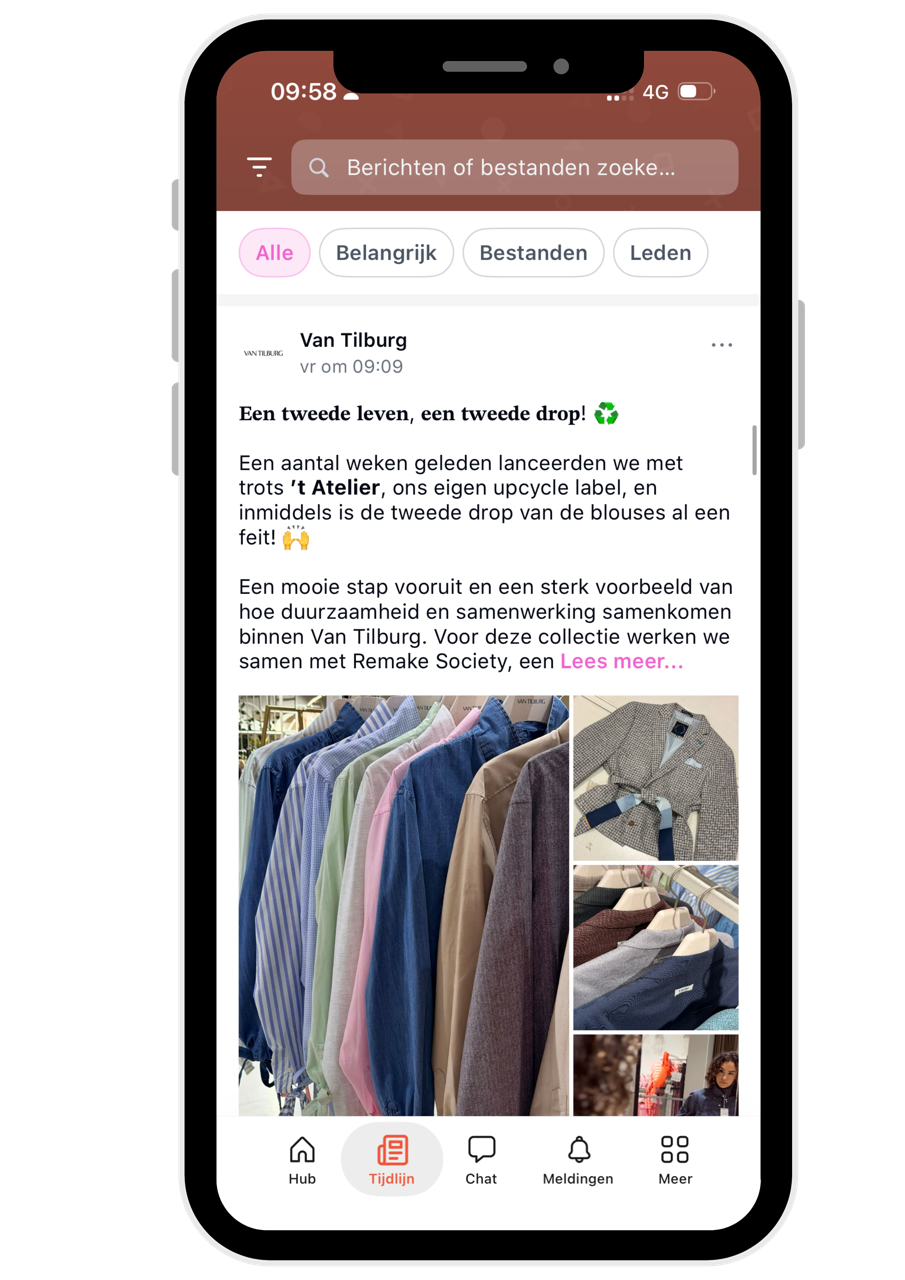
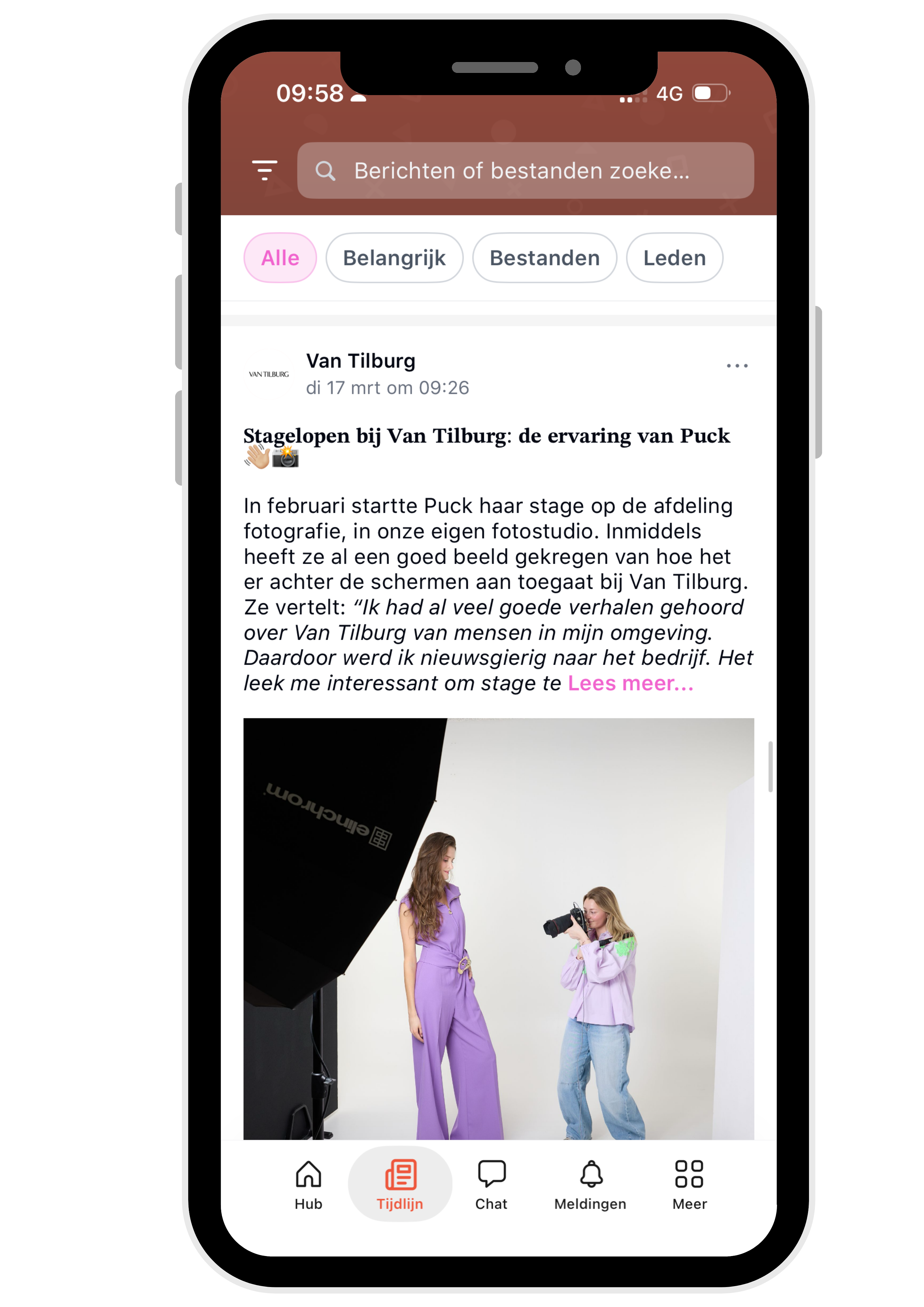
At the same time, Onetteam is not just a place for updates from the organization. Colleagues actively use the platform themselves too, for example when a department just received a new collection, or when a team organized something special.
"You notice that colleagues get to know more about each other," Deveny says. "You'll hear things like: nice, your post on Oneteam. Or: I had no idea you'd worked here this long." That kind of interaction happened much less before, simply because those stories weren't shared across the organization.
Oneteam also plays a clear role around events on the shop floor. From brand events to bigger themed days: colleagues stay up to date through the app on what's happening, so they can bring that into conversations with customers too. "Because it stays top of mind, colleagues also seem to pay more attention to ongoing promotions when talking to customers," Deveny says.
It's changed the daily briefing too. The most important matters are still covered there, but with practical updates now living on the timeline, there's more room during the briefing for compliments, customer needs and small team challenges.

Less hassle, more clarity
Beyond communication, the platform also makes practical processes simpler.
One clear example is expensing sports subscriptions. Where that used to go through separate emails, it now runs through a form in Oneteam. "Colleagues fill in their details and upload a receipt, and finance can download everything at once," Deveny says. About 300 colleagues fill in that form twice a year, which by her rough estimate saves around 50 hours of work a year.
Contact between colleagues has changed too. Since not everyone has a work email, a lot used to be arranged over WhatsApp. Now that happens through chat in Oneteam. "For example when someone wants to swap a shift or has a question," Deveny explains. "You can just find each other, without exchanging phone numbers."
At the same time, that brings more peace of mind, because work communication stays within one place. Colleagues decide for themselves when to check messages and whether to turn on notifications. That makes a real difference, especially in an organization where many colleagues work irregular hours.
Perhaps what stands out most is how quickly it's become part of daily practice. "In the beginning, people needed some time to get used to it," Deveny says. "But now colleagues know: if something's going on, it's on Oneteam."
Conclusion
For Van Tilburg, the biggest value of Oneteam lies in strengthening the connection between colleagues. People get more insight into what's happening, get to know each other better, and feel part of the whole more quickly.
"You see more engagement, and more pride in working at Van Tilburg," Deveny says. "Colleagues share what they're doing or have achieved, and that's genuinely noticed."
Van Tilburg's last employee engagement survey already showed a clear rise in communication scores, and in conversations, colleagues consistently describe the communication as clearer and more open.
At the same time, the platform makes day-to-day work more organized, since everything related to the employee experience comes together in one place. "For us, it feels completely natural by now," Deveny says. "We often have moments where we think: this would be nice to share on Oneteam."
Looking ahead, Van Tilburg wants to expand the platform further, including more use of events, forms and open groups colleagues can join. "So that more can also come from colleagues themselves," Deveny says.
The collaboration with Oneteam runs the way it should, she adds. "We don't have to think about it much, it just works. And if something comes up, it's picked up quickly."


In this article


