Smeding
In this customer story, you’ll read how Smeding uses Oneteam to make internal communication easier, improve onboarding, and bring colleagues across two locations closer together.
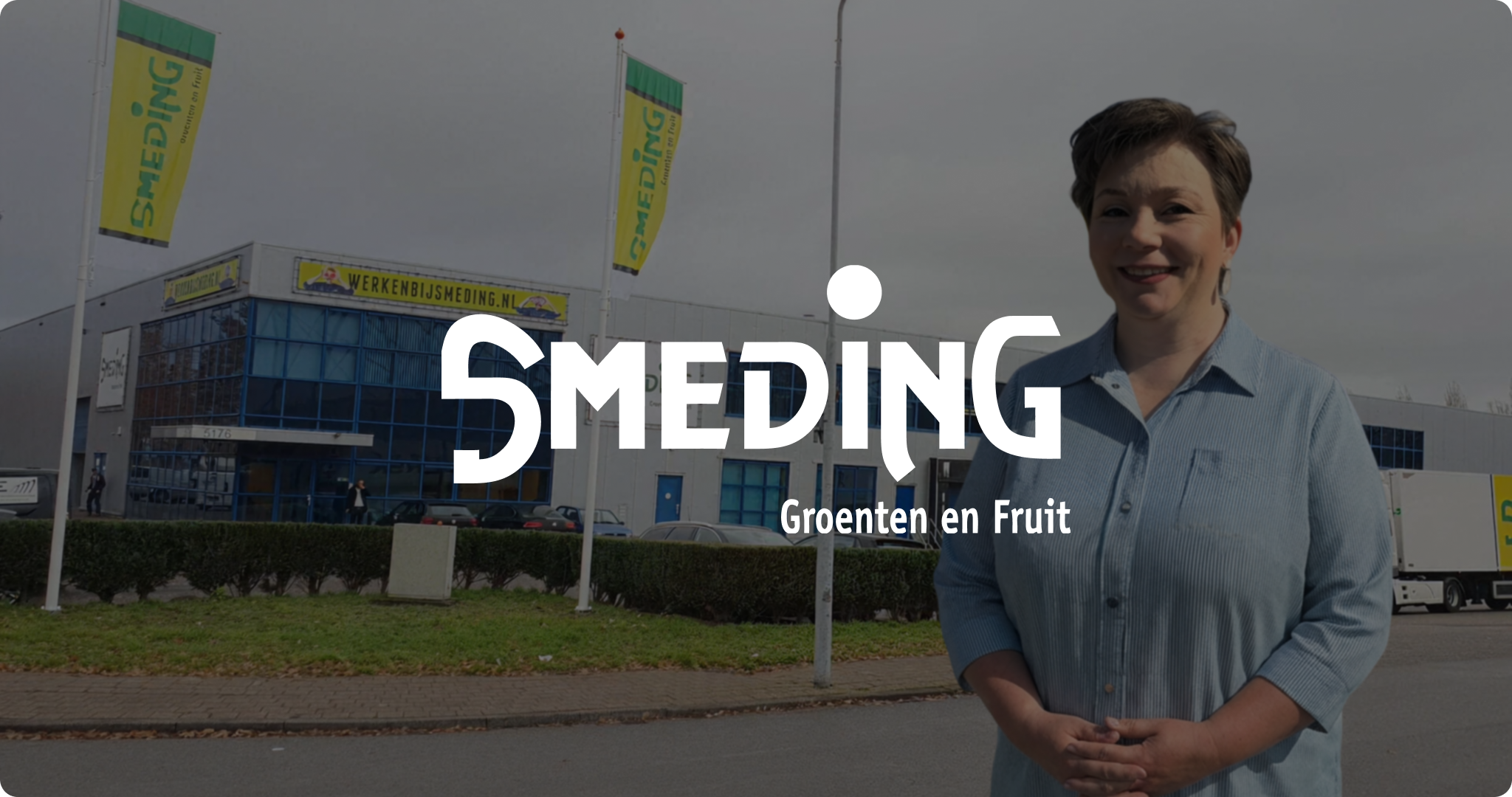
“With Oneteam, we now have one central place for our internal communication. Messages are being read, people respond, and everyone knows where to go for information and updates.”
– Linda Visser-Stam, HR Officer at Smeding
About Smeding
Smeding is a logistics partner in the fresh produce sector. From its headquarters and distribution center in Sint Annaparochie, products are sourced, stored, and delivered to retail and foodservice customers. They also operate a second distribution center in Geldermalsen, where they support partners including EDEKA.
In total, around 380 colleagues work at Smeding, from office teams to warehouse staff, team leaders, and a flexible group of temporary workers. Two locations, different types of work, different schedules, but still one organization.

The challenge
Around 2021, internal communication became part of HR, taking over from the marketing and communications team. At first, not much changed in how things were done. “We continued with newsletters the way we always had,” says Linda. “But we were missing connection. A newsletter is one-way communication, so people don’t really respond to it.”
Exit interviews and surveys made one thing clear: employees wanted more communication. Not just practical updates, but also a better understanding of how the company was doing. “People just want to know what’s going on. How are we doing? What’s changing? And what does that mean for us?” Linda explains.
At the same time, HR noticed that information didn’t always flow naturally across the organization. Important updates didn’t consistently reach everyone, and there was limited visibility into what was happening across teams and locations. This made it harder to keep everyone aligned and involved.
Onboarding new employees was another area that could be improved. While new starters received explanations on the job and a welcome package, mandatory training was not always offered right away.
“Some trainings were only given once there were enough new starters to form a group,” says Linda. “That sometimes meant waiting a few months. We wanted to make that faster and more structured, so people could get up to speed earlier.”
Alongside newsletters, Smeding also used digital screens to share updates. This worked well for short messages, but offered little room for explanation or interaction. On top of that, employees had to be in the right place at the right time to see the update.
Meanwhile, Smeding continued to grow. With the opening of the second distribution center in Geldermalsen, the physical distance between colleagues increased. “Sometimes it really feels like two separate locations,” Linda says. “But we want people to feel part of one Smeding.”
All of this made the need increasingly clear: one place where communication, onboarding, and practical information come together.

The solution
That’s when Oneteam came into the picture. The HR manager at the time introduced the platform as a way to rethink both internal communication and onboarding.
“We really wanted to do things differently,” Linda explains. “When communication moved to our HR team, it felt like the right moment to also improve how we organize it.”
What stood out right away was that Oneteam offered more than just a timeline for updates. It made it possible to bring onboarding, e-learning, forms, and documents together in one place.
“Especially for training, we immediately saw the value,” says Linda. “You can assign it straight away to new employees, instead of waiting until you have a full group. That makes a big difference in how quickly people can get started.”
The ability to target messages by location or team also fit well with how Smeding operates, across two sites with different day-to-day realities.
The approach
Together with an external marketing agency, Smeding prepared the launch of Oneteam. Posters and digital screens were used to introduce the platform and encourage employees to download the app.
In the first phase, the focus was on building a strong and clear foundation. The platform was filled with timeline updates, an onboarding program with quiz questions, mandatory e-learnings, and a range of forms and document.
“We made sure everything our employees need to know is available through Oneteam,” says Linda. “If you want to stay informed, the app is where you go.”
The results
Smeding is still actively working on further improvements, but the difference compared to a few years ago is already clearly visible.
Out of 380 employees, 95% are now on Oneteam. This means almost everyone can be reached through one platform, whether they work in the office, on the road, or in the distribution center.
“Messages are really being read, we can see that cleary from the statistics.” Linda says. “We never had that kind of reach with email newsletters.”
More interaction instead of one-way communication
Where communication used to be limited to a monthly newsletter, it has now become much more interactive.
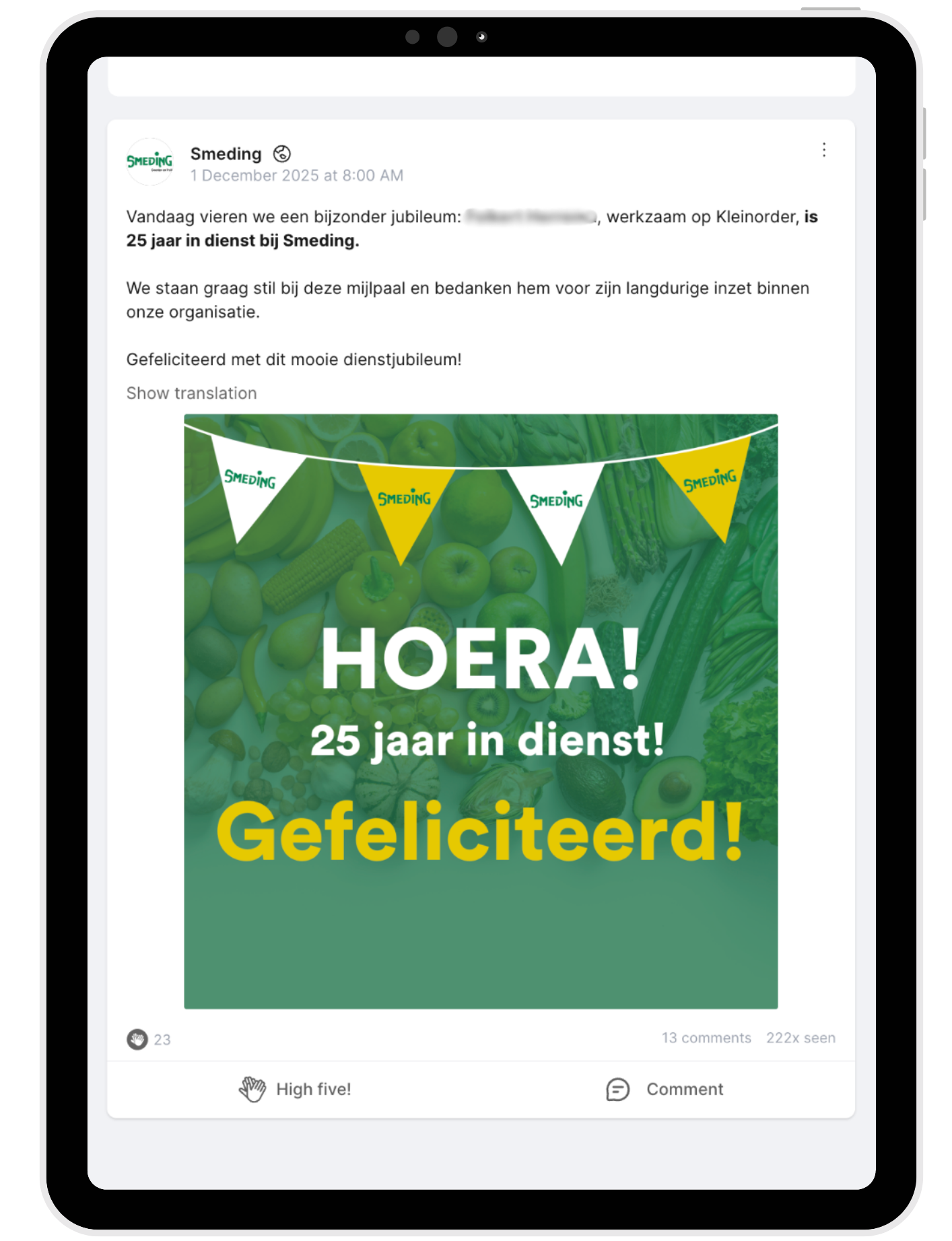
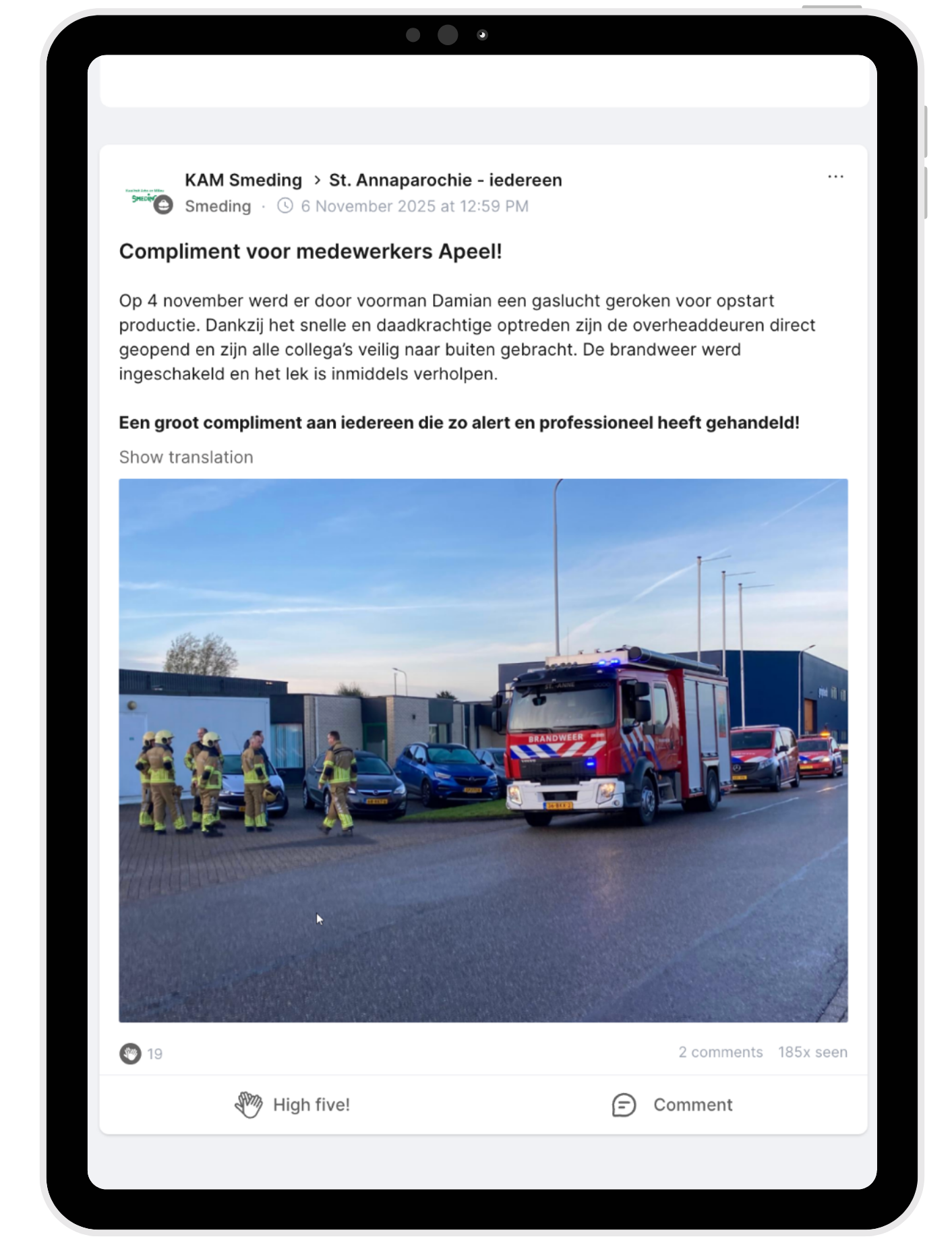
“People regularly respond to posts, giving high-fives or leaving a comment.” Linda explains. “And within certain groups, colleagues also communicate a lot with each other. That’s exactly what we wanted: not just reading, but also responding and engaging.”
Within the organization, Oneteam has become the go-to place for internal communication. “Sometimes I hear a colleague say, ‘I haven’t seen it on Oneteam yet.’ That’s when you know people really see it as the place where information should be,” says Linda.
Better onboarding and training
New employees now start with an online onboarding program in Oneteam. This helps them understand who Smeding is and how the organization works, supported by short quiz questions to check whether the information is clear.
Mandatory e-learnings are also available from day one, covering topics such as working safely in the distribution center and other safety instructions.
“Before, you had to wait until there were enough new employees for a group training,” Linda says. “Now you can get someone started immediately, which helps them settle in much faster.”
Practical matters handled faster
Oneteam is also increasingly used for practical matters. Forms are used for event registrations, but also for an idea box where employees can share suggestions or improvements.
Documents such as the collective labor agreement and leave policies are centrally available in the app. This allows employees to find information themselves, without needing to ask their manager.
“That saves a lot of separate questions,” says Linda. “People can simply look things up whenever it suits them.”
One Smeding
Smeding now shares messages more targeted, based on location or team. This means employees only see what’s relevant to their day-to-day work, while still receiving company-wide updates when needed.
By bringing everything together in one place, it’s easier to keep everyone informed and connected, across both locations. “We don’t want it to feel like two separate places,” says Linda. “We want people to know what’s going on, no matter where they work.”
Conclusion
For Smeding, Oneteam has brought more clarity and one clear place for internal communication. With 95% of employees on the platform, reach is high, messages are being read, and colleagues actively engage. Training is now structured, easy to access, and simple to track.
“As an HR team, we’re still very happy we made this step,” says Linda. “And our employees really benefit from it.”
Looking ahead, the focus is on getting even more out of the platform. Together with their marketing agency and Oneteam, Smeding is reviewing what works well and where they can improve.
“We want to look at what we have, what we use, and how we can use it better,” Linda says. “There’s so much possible with Oneteam. It would be a shame not to make the most of it.”


In this article

.jpg)
